700 MHz -- Why is it so valuable?
The 700 MHz wireless spectrum auction is causing a lot of excitement, yet the reasons why can be obscure -- Paul DeBeasi explains its importance and how it works.

700 MHz introduction
On January 24, 2008, the U.S. Federal Communications Commission began auctioning licenses for spectrum blocks in the 700 MHz band. The spectrum was previously used for analog television but is now being repurposed for commercial and public-safety use. Many articles have been written about the auction. Most of them state that the 700 MHz band is considered "beachfront property," implying that this band is very valuable.
But why is it valuable? The reason most often cited is that the 700 MHz band has better propagation characteristics, but these articles do not explain why it has better propagation characteristics or how much better or, even, better compared to what.
Radio propagation and received power
To answer these questions, we need to learn about radio propagation. Radio propagation refers to the way radio waves behave as they travel from transmitter to receiver. Unfortunately, this topic is quite complex. A rigorous treatment of the subject involves advanced mathematics and must consider many factors, such as path loss, fading, and interference. For our purposes, however, we can reduce the complexity by simply focusing on received power. (After all, we are not radio engineers!) Received power refers to the amount of transmitted power that reaches the receiver. The more power received by a mobile device (e.g., your laptop), the more bits of information the transmitter (e.g., a cell tower) can transmit to the device, and the farther the signal can travel.
A fundamental characteristic of received power is that it decreases proportional to the inverse of frequency. Put another way, low-frequency signals propagate their transmitted power better than high-frequency signals. Therefore, a 700 MHz signal will propagate better than, let's say, a 2500 MHz signal (all other conditions being equal). How much better? Well, consider some of the commonly used frequency bands in the U.S.: Verizon Wireless and AT&T both use 850 MHz and 1900 MHz for their cellular service, T-Mobile uses 2100 MHz, and Sprint will use 2500 MHz for its mobile WiMAX service.
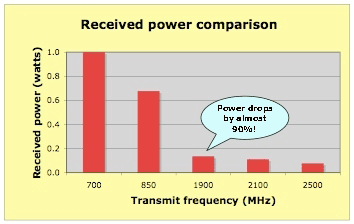
Figure 1: Received power comparison
Figure 1 shows the received power for these commonly used frequency bands, compared with a 700 MHz signal with received power equal to 1 watt. The figure shows us that as transmitter frequency increases, received power drops very quickly. Look at the 1900 MHz frequency used by Verizon Wireless and AT&T. The received power for 1900 MHz is almost 90% less than the received power for 700 MHz!
Why does received power matter?
As the received power drops, it becomes more difficult for the receiver in your mobile device to decode the received signals. The transmitter compensates for this by reducing the transmit data rate. As the data rate decreases, so does your throughput.
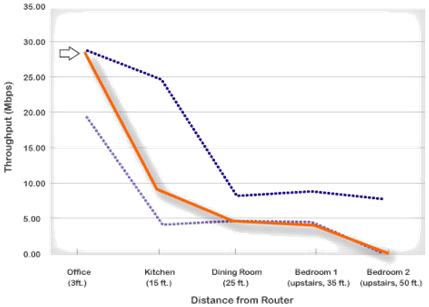
Figure 2: Throughput versus distance (Source: USA Today)
A Wi-Fi network in your home works the same way. As you move your laptop farther away from an access point, the received power drops. As the received power drops, the transmitter in an 802.11g access point reduces the data rate from 54 Mbps, to 48 Mbps, then to 36 Mbps, and so on, until eventually the receiver can't detect any received power and you lose your connection. Figure 2 shows throughput versus distance for three consumer access points. (The curve in orange is Apple's AirPort Express.) The figure shows how throughput decreases as the test laptop moves farther away from the wireless router.
Conclusion
Many consider the 700 MHz band to be highly valuable "beachfront" property. One of the major reasons the band is so valuable is that the received power from a 700 MHz signal is considerably higher than from signals operating in commonly used bands such as 1900 MHz. The 700 MHz band will enable service providers to deploy higher-performance mobile broadband services over greater distances than the services they offer today.
More information
For those of you who find this topic fascinating (no laughing please!) refer to "Deploying License-Free Wireless Wide-Area Networks" by Jack Unger, and "Fundamentals of WiMAX" by Jeffrey G. Andrews, et al.
 |
|
 |
|
|
|
Paul is a well-known conference speaker and has spoken at many events including Interop, Next Generation Networks, WiFi Planet, Internet Telephony and more.