personal area network (PAN)

What is a personal area network (PAN) and how does it work?
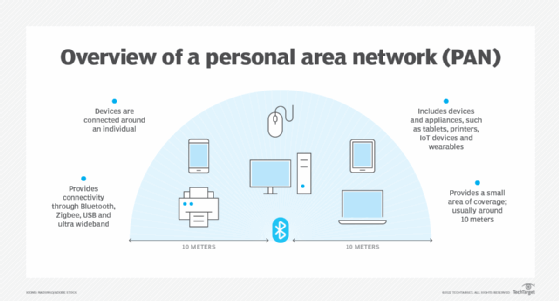
A personal area network (PAN) interconnects technology devices, typically within the range of a single user, which is approximately 10 meters or 33 feet. This type of network is designed to enable devices in a small office or home office (SOHO) environment to communicate and share resources, data and applications either wired or wirelessly.
PANs typically consist of laptops, smartphones, tablets, wearables, printers and entertainment devices. These devices are generally interconnected using some form of wireless technology. This kind of PAN could also be connected to the internet or other networks without wires.
The concept of a PAN was first developed by Thomas Zimmerman and other researchers at MIT's Media Lab and was later supported by IBM's Almaden research lab.
Types of PANs
There are two types of PANs: wireless and wired.
Wireless PANs. A wireless PAN is designed to serve a single person, SOHO or small workgroup. As such, limited distance, throughput, peripheral sharing and low volume are some of the main characteristics of this type of network. A wireless PAN functions wirelessly and is carried over a low-powered, short-distance wireless network technology, such as Infrared Data Association (IrDA), wireless universal serial bus (USB), Bluetooth, ultra wideband or Zigbee.
Conceptually, the difference between a PAN and a wireless local area network (LAN) is that the former tends to be centered around one person while the latter is connected without wires and serves multiple users.
Wired PANs. These networks provide short connections between peripherals using wired technologies, such as USB, IEEE-1394 high-performance serial buses or a Thunderbolt hardware interface.
Common use cases for a personal area network
A PAN has several use cases and applications. The following are the most common examples:
Body area network. Also referred to as a wireless body area network or a body sensor network, it's a type of mobile computer network that moves with a person and is typically established when a person connects their smartphone and Bluetooth headphone. With this network, communication takes place entirely within, on and in the immediate proximity of a person. An example of a body area network is a medical sensor that has wireless connections implanted in the human body to monitor vital signs.
Wearable technology. Wearable computer devices, including smart clothing and smart watches with accelerometers, can monitor daily activities and exchange digital information using the electrical conductivity of the human body as a data network.
Offline network. This is also referred to as a home network, as users can establish this type of network in their home offices. Multiple devices, including printers, TVs, game systems, laptops and other home appliances are integrated together through Bluetooth or Wi-Fi, forming a small, single-space network. However, the devices in this network aren't connected to the internet.
SOHO. This type of network is set specifically for work purposes and is separate from other home networks. Using an internet connection, this virtual network is typically a small setup of connected devices that are used solely for office work and may incorporate a virtual private network.
What's the difference between a PAN and a LAN?
PANs and LANs are unique in their own ways. The major difference between these networks is that a PAN connects the devices within the short range of an individual person, whereas a LAN connects devices at a single site, typically an office building. Similar to a PAN, a LAN can be both wired and wireless.
The following are a few main characteristics of a PAN and a LAN:
Characteristics of a PAN
- A PAN generally provides interconnection of technology devices surrounding a single user.
- Mainly used for low data-rate applications in home automation, it's widely used by
- PAN can include mobile devices and appliances, such as tablets, printers, keyboards, barcode scanners, game consoles, laptops and other personal devices.
- If connected wirelessly to the internet, it's called a wireless personal area network.
Characteristics of a LAN
- The scope of a LAN is usually within a single building or between buildings.
- A LAN is designed for high data transmission rates from megabytes per second to gigabytes per second.
- A Wi-Fi network is an example of a LAN. A LAN is typically established in houses, hospitals and educational institutions. For example, a Wi-Fi network for a university connects all the devices that are connected to it.
- The smallest LAN may only be made up of two computers, while larger LANs can accommodate thousands of computers.
- A LAN typically relies on wired connections for higher speeds and security, but wireless connections can also be part of a LAN.
- LANs are mainly used for their high speed and relatively low cost.
Advantages of PANs
A PAN can be very convenient and easy to set up. The following are a few benefits of using a PAN:
No wires are required. The connecting devices in a PAN only require Bluetooth to be enabled, which eliminates the need for extra wires. This also eradicates the need for cable management and wasted floor space, making it a highly cost-effective network.
Reliable and secure. A PAN network ensures a reliable and stable connection if it's established within the 10-meter range.
Easy data synchronization. A PAN provides easy data synchronization between different devices. As an example, all devices connected within a PAN can be used to exchange, download and upload data with each other.
Portability. A PAN provides extreme portability, as it's wireless, and users can transport devices and exchange data wherever they want.
Disadvantages of PANs
Along with its various advantages, a PAN also has several shortfalls, such as the following:
Short network range and slow data transfer. A PAN uses Bluetooth communication that doesn't span beyond the 10-meter range. This makes long-distance data sharing difficult and slows down the rate of data transfers.
Signal interference. The Bluetooth and IrDA rays used for transmission in a PAN can cause interference with radio signals, which can severely interrupt and degrade the quality of communication between devices.
Cost. Using a PAN can be expensive, as most built-in WPAN devices are costly. Also, most devices used for creating a PAN have a higher price tag, such as smartphones and laptops.
Line of sight propagation. PANs mostly operate on IrDA technology, which travels in a straight line from one point to another, also known as the line of sight propagation. Unlike radio-based communications, IrDA devices must be aligned to work. For example, a TV remote won't work unless it's beamed directly to the TV screen.
Networks can differ based on size, connectivity, design and coverage. Explore the seven common network types, along with their benefits and use cases.