GSM (Global System for Mobile communication)
What is GSM (Global System for Mobile communication)?
GSM (Global System for Mobile communication) is a digital mobile network that is widely used by mobile phone users in Europe and other parts of the world. GSM uses a variation of time division multiple access (TDMA) and is the most widely used of the three digital wireless telephony technologies: TDMA, GSM and code-division multiple access (CDMA). GSM digitizes and compresses data, then sends it down a channel with two other streams of user data, each in its own time slot. It operates at either the 900 megahertz (MHz) or 1,800 MHz frequency band.
GSM, together with other technologies, is part of the evolution of wireless mobile telecommunications that includes High-Speed Circuit-Switched Data (HSCSD), General Packet Radio Service (GPRS), Enhanced Data GSM Environment (EDGE) and Universal Mobile Telecommunications Service (UMTS).
History
Predecessors to GSM, including Advanced Mobile Phone Service (AMPS) in the U.S. and Total Access Communication System (TACS) in the U.K., were built with analog technology. However, these telecommunications systems were unable to scale with the adoption of more users. The shortcomings of these systems signaled the need for a more efficient cellular technology that could also be used internationally.
To achieve that goal, in 1983, the European Conference of Postal and Telecommunications Administrations (CEPT) set up a committee to develop a European standard for digital telecommunications. CEPT decided on several criteria that the new system must meet: international roaming support, high speech quality, support for hand-held devices, low service cost, support for new services and Integrated Services Digital Network (ISDN) capability.
In 1987, representatives from 13 European countries signed a contract to deploy a telecommunications standard. The European Union (EU) then passed laws to require GSM as a standard in Europe. In 1989, the responsibility of the GSM project was transferred from CEPT to the European Telecommunications Standards Institute (ETSI).
Mobile services based on GSM were first launched in Finland in 1991. That same year, the GSM standard frequency band was expanded from 900 MHz to 1,800 MHz. In 2010, GSM represented 80% of the global mobile market. However, several telecommunications carriers have decommissioned their GSM networks, including Telstra in Australia. In 2017, Singapore retired its 2G GSM network.
Composition of the network
The GSM network has four separate parts that work together to function as a whole: the mobile device itself, the base station subsystem (BSS), the network switching subsystem (NSS) and the operation and support subsystem (OSS).
The mobile device connects to the network via hardware. The subscriber identity module (SIM) card provides the network with identifying information about the mobile user.
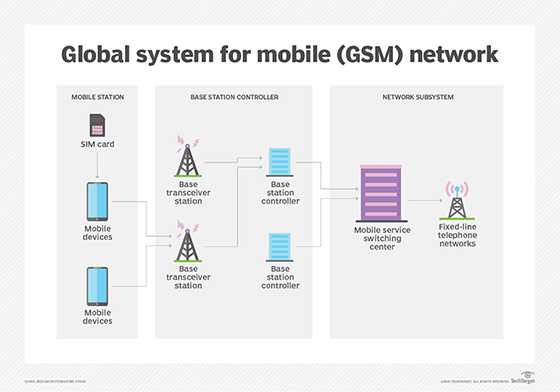
The BSS handles traffic between the cellphone and the NSS. It consists of two main components: the base transceiver station (BTS) and the base station controller (BSC). The BTS contains the equipment that communicates with the mobile phones, largely the radio transmitter receivers and antennas, while the BSC is the intelligence behind it. The BSC communicates with and controls a group of base transceiver stations.
The NSS portion of the GSM network architecture, often called the core network, tracks the location of callers to enable the delivery of cellular services. Mobile carriers own the NSS. The NSS has a variety of parts, including mobile switching center (MSC) and home location register (HLR). These components perform different functions, such as routing calls and Short Message Service (SMS) and authenticating and storing caller account information via SIM cards.
Because many GSM network operators have roaming agreements with foreign operators, users can often continue to use their phones when they travel to other countries. SIM cards that hold home network access configurations may be switched to those with metered local access, significantly reducing roaming costs, while experiencing no reductions in service.
Security details
Although GSM was designed as a secure wireless system, it can still experience attacks. GSM uses authentication measures, such as challenge-response authentication, which prompts a user to provide a valid answer to a question, and a preshared key that is in the form of a password or passphrase.
There are a few cryptographic security algorithms that GMS employs, including stream ciphers that encrypt plaintext digits. A5/1, A5/2 and A5/3 are three stream ciphers that ensure a user's conversation is private. However, the algorithms for both A5/1 and A5/2 have been broken and published and are therefore susceptible to plaintext attacks.
GSM uses GPRS, a packet-based communication service, to transmit data, such as through web browsing. However, the ciphers that GPRS uses, GEA1 and GEA2, were broken and published as well in 2011. Researchers published open source software to sniff packets in the GPRS network.
What are GSM vs. CDMA vs. LTE differences?
The big difference among GSM, CDMA and LTE (long-term evolution) cellular-wireless communications is the technology behind them and the business objectives each is designed to meet. GSM is the oldest of the three. Developed and adopted as a standard in Europe, GSM used the processor/chip technologies available at the time to encode and decode data.
For a time, mobile operators deployed 2G GSM across many countries worldwide except for the U.S. and several countries in South America. Incompatibility with existing analog AMPS systems largely drove these exceptions. To provide the necessary interim compatibility with GSM, they evaluated GSM's economies of scale for their networks. Carriers employed D-AMPS (Digital-Advanced Mobile Phone Service), a digital version of AMPS based on Interim Standard (IS)-136 for TDMA networking (itself an evolution of the original 2GL D-AMPS standard, IS-54) from the Electronics Industries Association/Telecommunication Industry Association. It eventually became clear that TDMA protocols weren't sufficiently spectrum efficient to support fast-growing cellular services, however. This led to the introduction of CDMA protocols.
ITU IS-95, also known as cdmaOne, became the CDMA digital cellular standard in 1993, gaining popularity in countries using older Analog AMPS systems. That said, IS-95 needed powerful processors because coding and decoding CDMA required significantly more compute power than decoding and coding TDMA. As a result, CDMA phones were more expensive than GSM models.
Cellular technology evolved from there. For data, GSM introduced GPRS, which led to EDGE, while cdmaOne led to ANSI-2000 1xRTT. That, in turn, led to EV-DO. Because of their superior efficiency, 3GPP adopted CDMA protocols under Wide-Band CDMA (W-CDMA) for implementation in 3G UMTS.
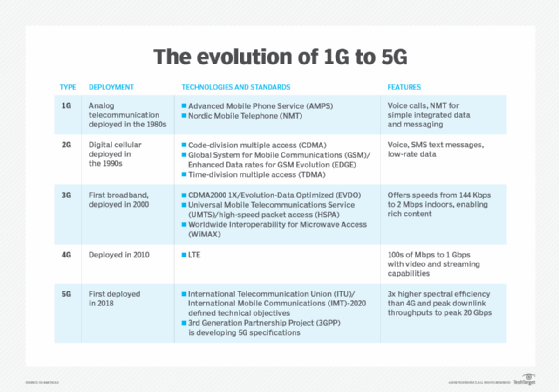
By contrast, 4G LTE is a GSM technology and a major upgrade over 3G in terms of data transfer speeds. It offers no way of making phone calls in the traditional sense, however. To make regular phone calls, LTE uses specialized voice over Internet Protocol (VoIP) for what's referred to as VoLTE.
CDMA and GSM technologies eventually converged through Orthogonal Frequency Division Multiple Access (OFDMA), LTE's encoding protocol. OFDMA is also the encoding protocol used for WiMAX and Wi-Fi networks.
As 5G becomes more commonplace, there's an expectation that it will come with new encoding protocols. It's still too early to predict whether 5G will be a progressive evolution in telecommunications or mark a technological revolution in this market. Either way, most telecommunication industry watchers agree that its effects will be global in scale and dramatic.
GSM or CDMA: Which is more popular?
Between GSM and CDMA, GSM -- and, by extension, its descendants 5G New Radio (NR), UMTS and LTE -- is more popular. GSM-based technologies are deployed in practically every country in the world.
CDMA, by contrast, is currently used in less than 10 countries. Furthermore, carriers will shut down almost all those CDMA networks in the next five years.
What are some limitations of GSM?
Though GSM is the preferred technology for today's telecommunication ecosystems, it isn't without its shortcomings. The following are some disadvantages of GSM:
Electronic interference. Because GSM uses a pulse-transmission technology, it is known to interfere with electronics like hearing aids. This electromagnetic interference is why certain places like airports, gas stations and hospitals require mobile phones be turned off.
Bandwidth lag. When using GSM technologies, multiple users access the same bandwidth, sometimes resulting in considerable latency as more users join the network.
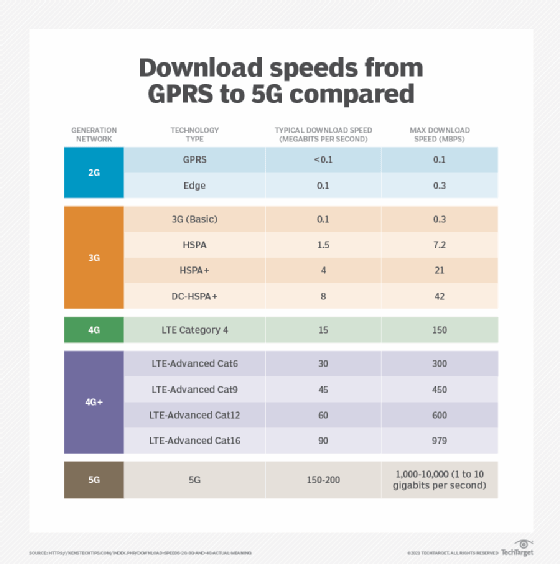
Limited rate of data transfer. GSM offers a somewhat limited data transfer rate. To achieve higher data rates, a user must switch to a device with more advanced forms of GSM.
Repeaters. GSM technologies require carriers to install repeaters to increase coverage.
Which carrier networks use GSM in the U.S.?
The following are some GSM networks in the U.S.:
- AT&T
- T-Mobile USA Inc.
- Telecom North America Mobile Inc.
- Union Wireless
- Viaero Wireless
- Cellular One
- Cordova Wireless
- Corr Wireless
- NEP Wireless
- Pine Cellular
- Plateau Wireless
- West Central Wireless
- XIT Communications
- Westlink
- DTC Wireless
- Epic PCS
- Earthtones
- Fuzion Mobile
- i-Wireless
- Indigo Wireless
- Immix