transponder

What is a transponder?
A transponder is a wireless communication, monitoring or control device that picks up and automatically responds to an incoming signal. The term is a combination of transmitter and responder.
Transponders are typically used for detecting, identifying and locating objects, but they can also be used in other technologies, such as in satellites to relay communications signals. Transponders are commonly found in both civilian and military aircraft and in objects, such as car keys.
What are transponders used for?
Transponders are used with the following technologies:
- aircraft identification;
- communications satellites;
- vehicle keys;
- optical communications;
- sonar;
- electronic toll collection systems;
- lap timing and tire identification for motor sports; and
- magnetic labels on credit cards.
How do transponders work?
Transponders operate using radio frequencies and respond to wireless monitoring, communications and control device signals.
When sent a signal -- also called an interrogator -- a transponder responds by returning an identifying signal. The information included in the response varies depending on the type of transponder but can include location and identifying codes. The transponder automatically sends back a radio signal at a predetermined frequency. To receive and send signals simultaneously, receiving and transmitting signals must be set at different frequencies.
An air traffic controller can send an interrogator signal and receive identifying information on an aircraft. This enables the control tower to track the aircraft in the surrounding airspace and provide other information to help the pilots maintain adequate distance from other aircraft.
Transponders in aircraft can be classified as Mode A, C or S and work in the following ways:
- Mode A transponders transmit an identifying transponder code -- also called a squawk code -- to air traffic control.
- Mode C transponders transmit the identifying code and aircraft altitude to air traffic control.
- Mode S transponders transmit the identifying code, aircraft altitude, registration information and speed to air traffic control and other in-range aircraft with Mode S transponders.
Aircraft with Mode S transponders also support airborne collision and avoidance systems and traffic collision and avoidance systems.
Transponders can be integrated into chipped car keys. When a transponder key is inserted or a key fob is pushed, a receiver in the ignition's circuitry picks up the signal. If the transponder's serial number matches the car's programmed number, the vehicle starts when the user inserts the key or pushes the start button.
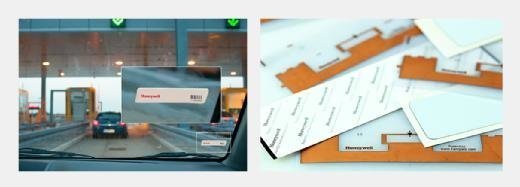
Electronic toll collection systems use transponders mounted on vehicle windshields or license plate readers to enable cashless toll collection. For example, the Florida Turnpike uses prepaid accounts, such as SunPass and E-PASS, to collect tolls on toll roads and bridges throughout the state. This eliminates the need for manned tollbooths.
Types of transponders
Transponders can be either passive or active. A passive transponder enables a computer or robot to identify an object. Magnetic labels -- such as those on credit cards and store items -- are common examples. A passive transponder must be used with an active sensor that decodes and transcribes the data the transponder contains. The transponder unit can be physically tiny, and its information can be sensed up to several feet away.
Simple active transponders are employed in location, identification and navigation systems for commercial and private aircraft. An example is a radio frequency identification (RFID) device that transmits a coded signal when it receives a request from a monitoring or control point. The transponder output signal is tracked, so the position of the transponder can be constantly monitored. The input (receiver) and output (transmitter) frequencies are pre-assigned. Transponders of this type can operate over distances of thousands of miles.
Sophisticated active transponders are used in communications satellites and on board space vehicles. They receive incoming signals over a range -- or band -- of frequencies and retransmit the signals on a different band at the same time. The device is similar to the type of repeater used in land-based cellular telephone networks. The incoming signal, usually originating from a point on the Earth's surface, is called the uplink. The outgoing signal, usually sent to a point or region on the surface, is called the downlink. These transponders sometimes operate on an interplanetary scale.
Learn more about transponders in RFID and how they compare to barcode use in a supply chain.