CDMA (Code-Division Multiple Access)

What is CDMA (Code-Division Multiple Access)?
CDMA (Code-Division Multiple Access) refers to any of several protocols used in second-generation (2G) and third-generation (3G) wireless communications. As the term implies, CDMA is a form of multiplexing, which allows numerous signals to occupy a single transmission channel, optimizing the use of available bandwidth. The technology is used in ultra-high-frequency (UHF) cellular phone systems in the 800 megahertz (MHz) and 1.9 gigahertz (GHz) bands.
CDMA employs analog-to-digital conversion (ADC) in combination with spread spectrum technology. Audio input is first digitized into binary elements. The frequency of the transmitted signal is then made to vary according to a defined pattern code. This enables the signal to be intercepted only by a receiver whose frequency response is programmed with the same code, following along with the transmitter frequency. There are trillions of possible frequency sequencing codes, which enhances privacy and makes cloning difficult.
How does CDMA work?
Cell clusters form the cellular structure of wireless CDMA networks. Each cell in a cell cluster has a transceiver with the necessary transmitting power and mobile units distributed around the cell's coverage area. Every mobile unit runs a transceiver, which consists of a low-power transmitter and a sensitive receiver operating with a wireless cellular environment. The characteristics of the cellular environment include multipath propagation, access interference and fading.
The near-far (N-F) effect plays a significant role in the quality of service (QoS) for CDMA systems. It refers to a phenomenon that occurs when a user near the base station sends out a transmission that interferes with and overpowers a weaker transmission signal coming from a user further away. To this end, CDMA network providers use receivers that are resistant to the N-F effect; they also use tight power control schemes.
The CDMA channel is nominally 1.23 MHz wide. CDMA networks use a scheme called soft handoff, which minimizes signal breakup as a handset passes from one cell to another. The combination of digital and spread spectrum modes supports several times as many signals per unit of bandwidth as analog modes. CDMA is compatible with other cellular technologies; this enables nationwide roaming. The original CDMA standard, also known as CDMA One, offers a transmission speed of only up to 14.4 kilobits per second in its single channel form and up to 115 Kbps in an eight-channel form. CDMA2000 and Wideband CDMA (W-CDMA) deliver data many times faster.
The CDMA2000 family of standards includes single-carrier Radio Transmission Technology (1xRTT), Evolution-Data Optimized Release 0, EVDO Revision A and EVDO Rev. B. People often confuse CDMA2000, which is a family of standards supported by Verizon and Sprint, with CDMA, which is the physical layer multiplexing scheme.
What is the difference between GSM and CDMA?
Most people often get caught up in the CDMA vs. Global System for Mobile Communication (GSM) divide when trying to transfer their phones from one cellular network provider to another. Some carriers' phones are designed to operate only on their radio network, and they're incompatible with other networks' cellular communications technologies. This was especially rife some years back. In recent years, device manufacturers have been designing phones that users can operate on both CDMA and GSM networks.
GSM and CDMA are multiple-access technologies that enable numerous data connections and multiple calls on a single radio channel. CDMA cellular systems use a unique code to encode every call's data and then transmit all those calls at once. On the other end, the receivers divide the combined signal into their individual calls before channeling them to the intended recipient. GSM transforms every call into digital data, transmits it via a shared channel at a specific time and then puts each call back together at the other end of the line for the intended recipient.
Which carriers are CDMA? Which are GSM? GSM is available in more than 200 countries. CDMA is most widely used in the U.S. by carriers such as U.S. Cellular and Verizon. GSM carriers in the U.S. include T-Mobile and AT&T.
Which is better: CDMA or GSM?
With GSM networks, users can transmit data and make voice calls at the same time, an impossible feat for CDMA networks. But this is hardly the reason behind GSM's popularity. A big driver was Europe's 1987 law that required the use of GSM. Another reason was that GSM resulted from an industry consortium, while CDMA was, for the most part, owned by Qualcomm, making GSM-powered devices cheaper to make and use.
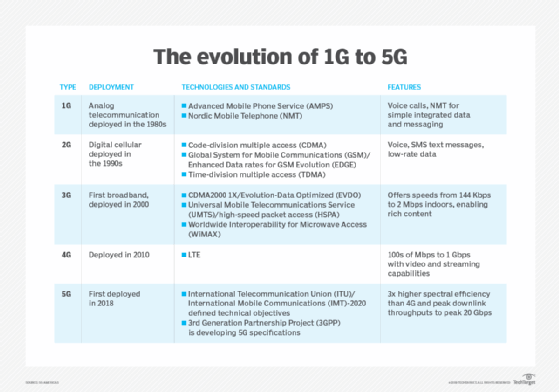
CDMA and GSM standards apply only to 2G and 3G connectivity. As the switch to fourth-generation wireless began in earnest in 2010, carriers adopted Long-Term Evolution (LTE), the global standard for 4G networks. Consequently, the distinction between CDMA and GSM is becoming less important as CDMA phones and devices powered by GSM networks vanish into history. But, for now, 2G and 3G networks still serve as backups for areas with weak 4G LTE signals.
5G cellular technology will replace old protocols
CDMA will become even less relevant with the advance of fifth-generation (5G) wireless systems. 5G promises to drastically improve the data transfer speeds possible on cellular networks to rival fiber-optic networks. The technology offers better broadband capacity, reliability and bandwidth, far beyond what's possible on 4G. Primarily, 5G is powered by millimeter wave (MM wave) bands in 26, 28, 38 and 60 GHz. At these frequency bands, data transfer speeds can rise as high as 20 gigabits per second (Gbps). Using massive multiple input, multiple output (MIMO) 64-256 antennas, 5G offers speeds at least 10 times greater than what's currently possible on 4G networks.
5G cellular technologies in the low-band and midband range use frequencies between 600 MHz and 6 GHz, with most occupying the 3.5 to 4.2 GHz range. In the U.S., the 5G wireless frequency bands already in use are 3,100 to 3,550 MHz and 3,700 to 4,200 MHz. Europe is deploying 3,400 to 3,800 MHz frequency bands, while Asia is using 3,300 to 3,600 MHz; 4,400 to 4,500 MHz; and 4,800 to 4,990 MHz bands.