hertz (Hz)

What is a hertz (Hz)?
Hertz (Hz) is the standard unit of frequency in the International System of Units (SI). It is a derived unit based on the second (s), one of the seven base units in the SI standard. The base units, in turn, are constructed from the seven SI defining constants. The SI equation for hertz is Hz = s-1 (also written as Hz = 1/s). In practice, this means that a hertz is equivalent 1 waveform cycle per second, when applied to electromagnetic (EM) radiation or to sound and other vibrations. Hertz replaces the earlier term of "cycle per second."
The hertz is used to measure specific frequencies. Frequency in this sense refers to the number of wave cycles that pass through a given point in one second, with each cycle representing a unit of time. Wave cycles are often represented as sinusoidal waveforms, as in the following illustration.
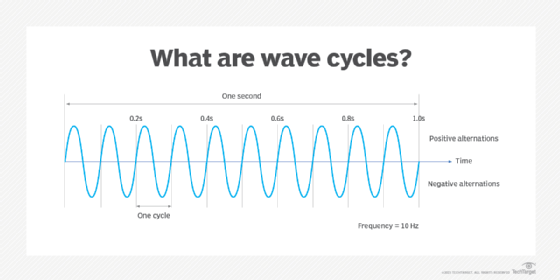
The curving blue line represents the waveform as it travels over a one-second interval, moving between positive alternations and negative alternations. The positive alternations rise above the axis, and the negative alternations are below. A full cycle includes two consecutive alternations, one positive and one negative. In this case, there are 10 full cycles, with each cycle taking 0.1 seconds to pass through a given point. Together the cycles add up to 10 per second, resulting in a frequency of 10 Hz.
Wave frequencies are inversely proportional to their wavelengths. The longer the wavelength, the lower the frequency. The shorter the wavelength, the higher the frequency. For example, a radio wave with a frequency of 3 × 10⁷ Hz has a wavelength of about 10 meters (m). However, a radio wave with a frequency of 3 × 10⁸ Hz has a wavelength of only 1 m. This means that the second radio wave has a frequency 10 times greater than the first one but a wavelength that's only one-tenth as long.
The hertz unit of measure is named after Heinrich Hertz (1857–1894), a German physicist credited with confirming James Clerk Maxwell's theory of electromagnetism. Hertz carried out a series of experiments that demonstrated the existence of EM radiation.

Common hertz multipliers
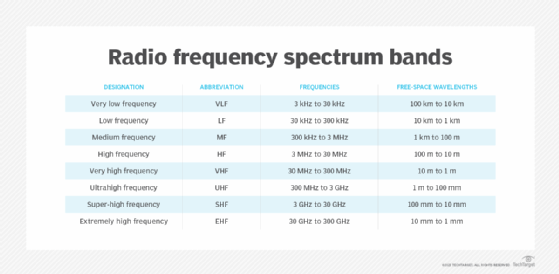
Frequencies and wavelengths vary substantially from one waveform to the next. For example, gamma rays can have frequencies greater than 1020 Hz and wavelengths less than 10-12 m. However, radio waves, which lie at the other end of the EM spectrum, can have frequencies below 3,000 Hz and wavelengths greater than 10,000 kilometers.
Because of the variations in waveforms and their range of values, hertz are commonly expressed in multipliers:
- attohertz = 10-18 Hz
- femtohertz = 10-15 Hz
- picohertz = 10-12 Hz
- nanohertz = 10-9 Hz
- microhertz = 10-6 Hz
- millihertz = 10-3 Hz
- kilohertz = 103 Hz
- megahertz = 106 Hz
- gigahertz = 109 Hz
- terahertz = 1012 Hz
- petahertz = 1015 Hz
- exahertz = 1018 Hz
There are other multipliers as well, but the ones listed here include those that are most commonly used, in addition to several that are not as common. Some resources do not use these multipliers but instead refer to hertz in scientific notation. For example, rather than saying 10 terahertz, they might use 1e+13, 1 x 10¹³, or simply 1013.
What is a hertz used for?
Hertz is often used to measure the frequency of EM radiation. Examples of its use can be found throughout our daily lives. In the United States, for example, the common household electrical supply has a frequency of 60 hertz, which means that the current changes direction or polarity 120 times, or 60 cycles per second. In Europe, the standard frequency is 50 hertz, or 50 cycles per second.
Broadcast transmissions, such as AM and FM radio, have much higher frequency rates, so they're usually expressed in kilohertz or megahertz. According to the US Federal Communications Commission, the AM radio band in this country ranges from 540 kHz to 1700 kHz, and the FM radio band ranges from 88.0 MHz to 108.0 MHz.
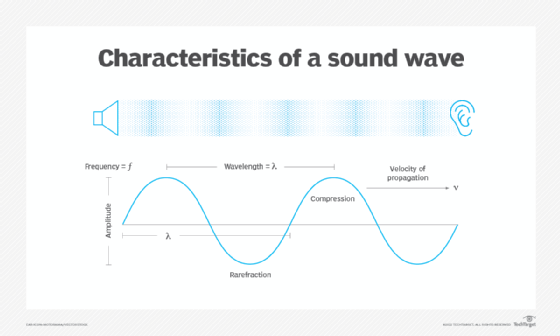
Hertz is also commonly used to measure vibrations, particularly acoustic sound. The range of human hearing is generally between about 20 Hz to 20 kHz. However, many factors can contribute to what a person can actually hear, such as age, disease, or repeated exposure to loud noises. Each musical note also has its own frequency, which is called its pitch. For instance, the pitch of middle C on a piano is 263 Hz. Hertz is also used to refer to an equalizer's individual sound controls, such as sub-bass or high-mids, which isolate specific frequency ranges.
Hertz is used in computing as well, although in a way slightly different from EM radiation or vibrations. For example, one of the key specifications used in describing a computer's CPU is its clock speed. In today's processors, clock speeds are typically measured in gigahertz. The clock speed indicates the number of pulse cycles the CPU can execute per second. The higher the clock speed, the more instructions that the CPU can process each second, leading to faster load times and better performance.
Learn about licensed and unlicensed wireless frequency bands and the 4 different types of wireless networks. See how CPU, GPU and data processing units differ from one another.