uplink and downlink

What are uplinks and downlinks?
In satellite telecommunication, a downlink is the link from a satellite down to one or more ground stations or receivers, and an uplink is the link from a ground station up to a satellite. Some companies sell uplink and downlink services to television stations, businesses and other telecommunication carriers. A company can specialize in providing uplinks, downlinks or both.
The following table shows the main frequency bands and frequency ranges used for satellite links.
| Frequency Band | Downlink | Uplink |
|---|---|---|
| C | 3,700-4,200 MHz | 5,925-6,425 MHz |
| Ku | 11.7-12.2 GHz | 14.0-14.5 GHz |
| Ka | 17.7-21.2 GHz | 27.5-31.0 GHz |
The C band is the most frequently used frequency band. The Ka and Ku bands are reserved for satellite communication. But they're subject to rain attenuation, which occurs when rain, snow and other precipitation interferes with signal propagation. Some satellites carry transponders for both C and Ku bands.
Downlink and uplink shouldn't be confused with downstream and upstream.
How uplinks and downlinks work in satellite networks
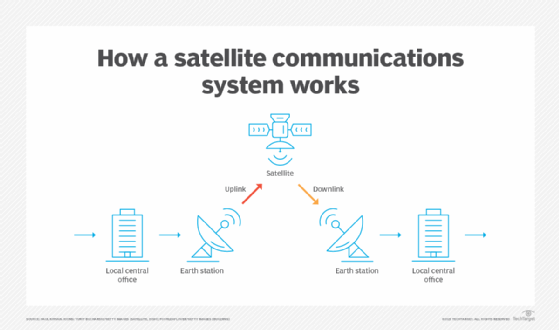
Downlink and uplink are the radio pathways that a satellite or cell tower uses to transmit or receive signals. The following are the steps involved:
- Signal generation. A specialized radio generates the signal used to send data from one ground station, also known as an earth station, to another via satellite.
- Amplification and uplink transmission. The signal is sent on an uplink frequency from the ground station to the satellite. Because it travels long distances between satellites and ground stations, the signal must be amplified or boosted. That way the uplink message arrives at the satellite with enough energy to be received.
- Reamplification. The satellite then boosts the signal again so it can be sent as a downlink to a receiving earth station.
- Downlink transmission. The signal is sent via a downlink frequency to the receiving earth station. Multiple broadcast downlinks can also be generated if a transmission will be delivered to multiple receivers.
In a satellite communications system, each earth station must have its radios and antennas set to the correct radio frequency, as described in the table above, to successfully receive and transmit over downlink and uplink paths.
Earth stations can be connected to an incumbent local exchange carrier (ILEC), a competitive local exchange carrier or a wireless network carrier. Downlink frequency differs from uplink frequency so that two-way communication can occur without the signals canceling out each other.
How uplinks and downlinks in mobile communications
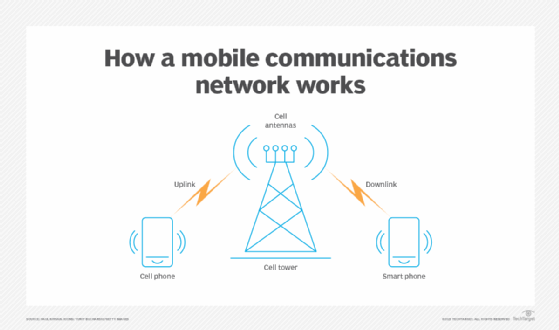
Like satellite communications, mobile telecommunications networks rely on uplinks and downlinks. Mobile networks use different frequency bands and ranges than satellites to avoid interference.
When a mobile device initiates a call, it establishes a wireless connection on an uplink frequency to a cell tower or base station. There, an amplifier provides a signal booster, and the signal then sent on a downlink frequency to the intended recipient or to an ILEC for completion to a standard wireline telephone. Signal strength for both downlink and uplink connections is essential to obtain the best mobile service.
Why are downlinks and uplinks important?
The development of radio communications made it possible to communicate over distances without the use of physical wires. Advances in satellite technology dating back to the early 1960s improved service quality and the geographic range that satellites cover. Networks became possible between satellites, enabling them to communicate with each other as well as with earth stations. It's now possible to communicate with virtually any place on the Earth's surface.
Uplinks and downlinks have been integral parts of wireless communications from the start. If either uplink or downlink capabilities are disabled, communication can't occur.
Severe weather and other atmospheric events that degrade the integrity of the atmosphere, such as solar storms, can disrupt uplinks and downlinks. Technology to compensate for such situations has improved over the years, but signals can still be affected when severe conditions occur.
Who uses uplinks and downlinks?
Businesses, government agencies and the military use satellite communication on a regular basis. Satellite technology is preferred in situations where users are located far from other mobile infrastructures, such as workers on oil rigs at sea.
Satellite phones and satellite phone services are typically more expensive are regular mobile phones and services. As a result they're often used in emergency situations where access to traditional wireless services isn't available.
Learn about direct satellite-to-cell phone communications advances with 5G.