HSDPA (High-Speed Downlink Packet Access)

What is HSDPA (High-Speed Downlink Packet Access)?
High-Speed Downlink Packet Access (HSPDA) is a packet-based mobile telephony protocol used in 3G Universal Mobile Telecommunications Service (UMTS) radio networks to increase data capacity and speed up download rates. Part of the HSPA standard, it offers a maximum theoretical download rate of 14.4 Mbps and accommodates simultaneous downloads, uploads and voice service. As an improved 3G cellular radio standard, it's sometimes called 3.5G or 3G+.
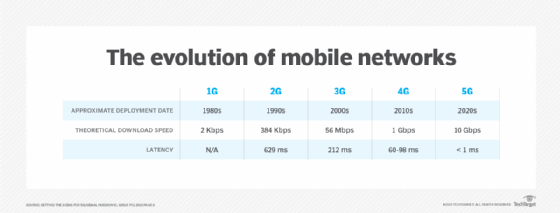
HSDPA improvements on 3G
The Third Generation Partnership Project (3GPP) standardized 3G UMTS in early 2000. Global System for Mobile (GSM) 2G networks use 3G UMTS, which applies wideband code-division multiple access (W-CDMA) radio technology. These first-release 3G networks only had maximum data rates of 128 Kbps.
To accelerate downloads and reduce latency, 3GPP standardized HSDPA in its Release 5 in 2002. This greatly decreased the cost of data transmission, making mobile data access practical for many end users. Improvements in the way data is transmitted, not hardware changes, made HSDPA faster. Existing towers required only software updates. The original W-CDMA standard only used quadrature phase-shift keying (QPSK) modulation, allowing only two bits to be transmitted per symbol. HSDPA added 16 quadrature amplitude modulation (16-QAM), supporting transmittal of four bits per symbol. The radio tower could switch between QPSK for better signal integrity or to 16-QAM for higher speed, depending on signal strength.
With improved scheduling and dynamic transmission times, cell towers gained more flexibility in transmission times. More radio time could go to the user requesting the most data instead of evenly splitting time among users who may not be requesting data.
Improved transmission error handling also allowed for higher speeds. Fast hybrid automatic repeat request (HARQ) adds forward error correction (FEC) to improve data transmission in bad signal conditions. The receiving modem can keep data that it could not decode for decoding later. These changes support faster speed and adaptive links no matter the signal strength.
HSDPA, HSPA+ and 4G
HSDPA was further extended in an HSPA update to Evolved HSPA, also called EVO-HSPA or HSPA+. These standards added several improvements.
They enabled 64-QAM, which allowed more bits to be transmitted per symbol. Multiple input, multiple output (MIMO) and Dual-Carrier HSDPA (DC-HSDPA, or Dual-Cell HSDPA) allowed several channels and cell towers to simultaneously transmit data to a single receiver, greatly increasing download capacity. These changes improved the theoretical download of HSPA+ from 28 Mbps to 42 Mbps all the way up to 168 Mbps, although such speeds were never seen in practice.
Due to its high speed and features, HSPA+ is classified as a 4G technology, although it is not true 4G because it's based on 3G standards. Many improved 3G technologies such as HSDPA and LTE were marketed as 4G. In reality, these technologies were fast enough to meet most user needs and few true 4G networks were deployed. HSDPA is not used in 4G LTE.
HSDPA and 5G NR
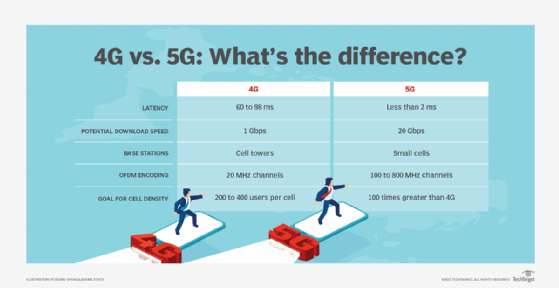
5G new radio (5G NR) technology is based on entirely new standards and does not use HSPA nor HSDPA as download standards. 5G NR still incorporates some of the same concepts as HSPA since both rely on wireless data transmission. For example, 5G NR can use 16-QAM and MIMO for faster speeds.
5G cellular technology has replaced the need for 3G cellular service. 5G offers much higher speeds in densely packed urban spaces. 5G low-band or C-Band service can cover a larger area than 3G at higher speeds.
HSDPA adoption and the future
HSDPA and HSPA were widely adopted technology enablers of 3G cell service. Because HSDPA and HSPA provide an easy upgrade path from GSM 2G networks with backward compatibility, they became widely used in Europe, where most carriers were using GSM 2G networks.
In the United States, GSM-based networks -- including AT&T, Cingular, T-Mobile, Verizon and Sprint -- did not use HSPA; they used the similar but incompatible CDMA2000 standard. HSPA also saw use in many Asian countries, including Japan, Taiwan and Malaysia. TD-SCMA, a similar but distinct standard, was used briefly in China.
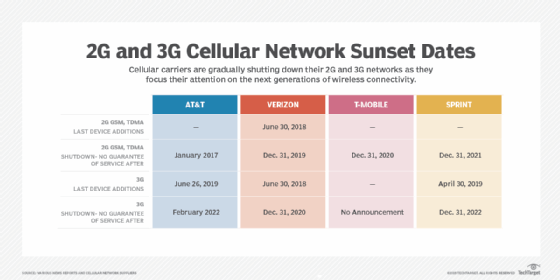
HSPA and other 3G technologies are being phased out and the networks are being decommissioned. 4G and 5G have become ubiquitous in most developed lands, making 3G obsolete. In some countries, all 3G service has already been disabled. In the U.S., it is expected that by the end of 2022 all the major carriers will have stopped providing 3G services.
In developing lands or countries with sparsely populated areas, HSPA 3G service may continue to be used until as late as 2026. This is because it offers a cost-effective way to cover large areas that isn't possible with 4G and would require expensive infrastructure and handset upgrades to get the same coverage with 5G NR service.
See also: mobile data, wireless, mobile data plan, carrier network, SIM card, 3G card, LTE-Advanced, GPRS, 2.5G and 6G.